The 7 Steps of Evidence-Based Practice
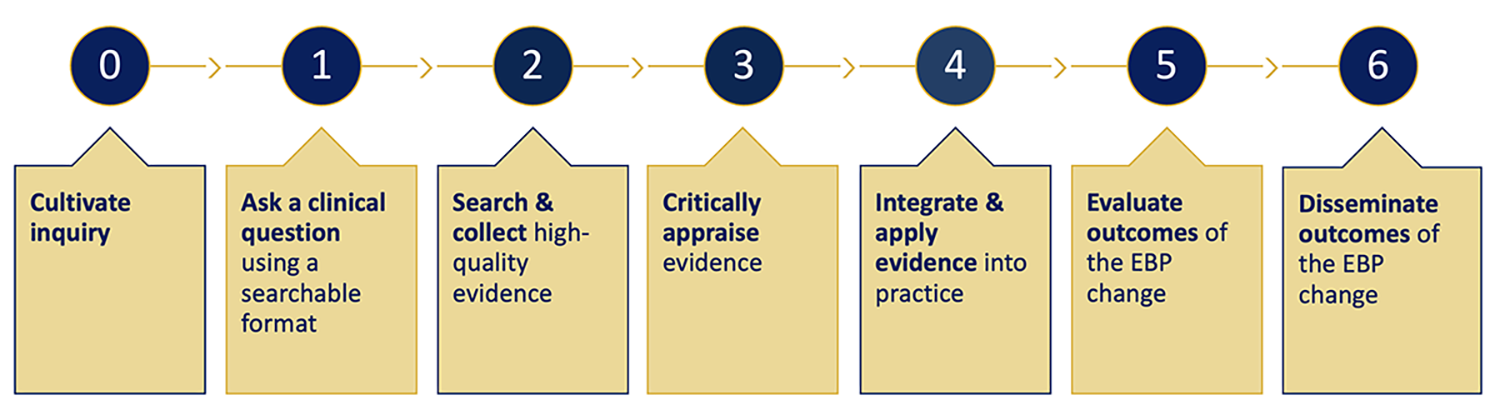 (Adapted from Melnyk et al. 2010; Image from UC Davis, 2025)
Step 0: Cultivate a Spirit of Inquiry
-
What it means: Foster an environment where questioning current practices and seeking better ways to provide care is encouraged and supported. It's about asking, "Why do we do it this way?"
Step 1: Ask Clinical Questions in PICOT Format
-
What it means: Formulate clear, answerable questions that guide your search for evidence.
-
PICOT stands for:
-
Patient/Population
-
Intervention/Interest
-
Comparison Intervention/Group
-
Outcome
-
Time (optional)
Step 2: Search for the Best Evidence
-
What it means: Systematically look for relevant research and evidence from reliable sources (e.g., databases like PubMed, CINAHL, Medline, Cochrane Library). Using a well-formulated PICOT question helps narrow the search.
Step 3: Critically Appraise the Evidence
-
What it means: Evaluate the quality, validity, reliability, and applicability of the gathered evidence to your clinical question. This involves assessing the research methods and findings.
Step 4: Integrate the Evidence with Clinical Expertise and Patient Preferences/Values
-
What it means: Combine the best available research evidence with your own clinical experience and the individual patient's unique preferences, values, and circumstances to make a clinical decision.
Step 5: Evaluate Outcomes of the Practice Decision or Change Based on Evidence
-
What it means: After implementing a change based on EBP, measure and monitor its effects on patient outcomes, cost-effectiveness, and other relevant indicators. Is the change making a difference?
Step 6: Disseminate EBP Results
-
What it means: Share the findings and outcomes of your EBP initiative with others through presentations, publications, or internal reports. This helps to build the body of evidence and promotes further EBP implementation.
Melnyk, B. M., Fineout-Overholt, E., Stillwell, S. B., & Williamson, K. M. (2010). Evidence-based practice: step by step: The seven steps of evidence-based practice. AJN, American Journal of Nursing, 110(1), 51–53. https://doi.org/10.1097/01.NAJ.0000366056.06605.d2
 Evidence-Based Practice in Nursing and Healthcare, 5th Edition
by
Evidence-Based Practice in Nursing and Healthcare, 5th Edition
by


